Cabot Learning Federation is committed to ensuring open, safe, secure, and well-maintained learning and working environments for its students, staff, visitors, and stakeholders.
To effectively manage the premises management obligations of the Trust and comply with all relevant government legislative requirements. To ensure the teaching and learning environment is safe and always welcoming.
Cabot Learning Federation comprises thirty-six academies within the Trust, two of which are PFI schools and Herons Moor Academy is a building owned by North Somerset Council. Some academies within the Trust require investment relating to their individual buildings and such works will, where appropriate, be supported via the School Conditions Allocation (SCA).
The buildings are assets that need to be maintained in order that they may function effectively and efficiently in supporting the delivery of education. Any deterioration in the physical condition of the building, due to a lack of maintenance, can adversely affect service delivery and create legal, health and safety and reputation issues for the Trust, and additional capital investment needs due to deteriorations.
The maintenance of buildings is critical to the effective management of assets.
The Trust aims to ensure that:
By adopting this approach, the Trust will agree ‘guiding principles for the management of maintenance and repair of Trust owned assets to ensure compliance with regulation and legislation.
This document is based on the Department for Education’s guidance on Good Estate Management for Schools (GEMS). This policy complies with the Trust’s funding agreement and articles of association.
The Board of Trustees, Director of Estates and Facilities, Deputy Director of Estates and Facilities, Estates Manager, Deputy Estates Managers, Academy Councils, Principals, Operations Managers and Premises Teams will ensure this Premises Management policy is implemented, and that tests and inspections are carried out in accordance with this policy.
The Director of Estates and Facilities, Deputy Director of Estates and Facilities, Estates Manager, Deputy Estates Managers, Principals, Operations Managers, and Premises Teams are responsible for ensuring that relevant risk assessments are carried out and that appropriate reporting is made to the Board of Trustees or Academy Council, as required.
The Deputy Estates Managers are responsible for:
The Premises Team is responsible for:
The PPM and Statutory Compliance appointed contractor is responsible for:
This Premises Management policy is based upon the following criteria in order of priority:
Planned Preventative Maintenance (PPM) is part of the planned or scheduled maintenance programme of the Trust. The purpose of the scheduled maintenance programme is to ensure the estates team anticipate maintenance requirements and make sure they are addressed in the most cost-effective manner.
The PPM programme focuses on major systems that keep the sites in operation.
This programme includes a list of the scheduled services/inspections and the frequency and interval at which that service/inspection must be performed.
The PPM schedule will be updated each time a system is added, updated, or replaced.
We maintain accurate records and details of all statutory tests which are undertaken across the premises. This includes relevant paperwork and certificates.
All requirements and recommendations highlighted in inspection reports and certificates are reviewed, tracked, and acted on, as necessary.
As part of the records of completed works, we include the dates when the work was undertaken and the details of the individual or company who completed them, along with their completion certificate or maintenance sheet.
PPM and statutory compliance activities across the Trust are outsourced to a single contractor to provide a streamlined and efficient approach to estates and facilities management. This model consolidates responsibility, enhances accountability, and ensures consistent service delivery. Drawing on specialist expertise improves compliance, reduces risk, and simplifies reporting. Financially, it delivers cost efficiencies through economies of scale and supports budgeting. Operationally, it frees up internal resources, optimises scheduling, and supports a more strategic focus across the Trust’s estate.
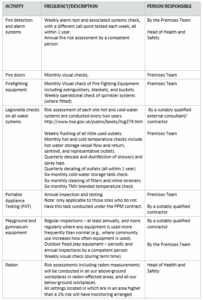
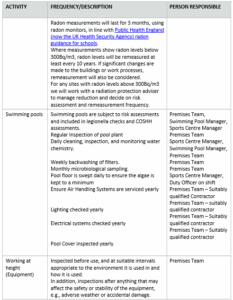
The table below outlines the areas subject to inspection, the frequency of those inspections, and the individuals responsible for conducting checks and engaging suitably qualified professionals to conduct inspection, testing, or maintenance where appropriate. It includes both statutory checks and recommended best practice checks based on relevant guidance. This framework is informed by the Department for Education’s guidance on good estate management for schools (GEMS).
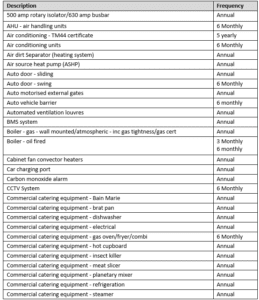
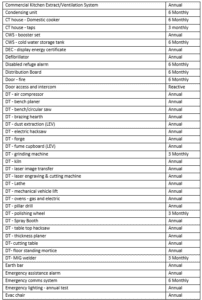
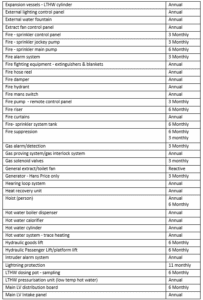
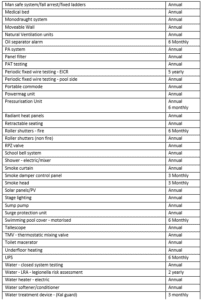
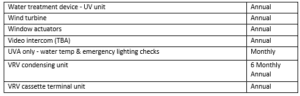
The following is managed outside of the CLF wide PPM & Statutory contract:
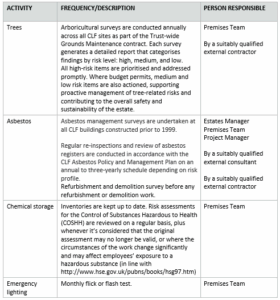
Condition Assessment / Surveys
Condition surveys are a key tool in identifying required maintenance and informing a structured programme of works. In line with best practice, these surveys will be conducted on a five-year cycle.
An annual programme is then developed through ‘Premises Management Plans,’ prioritising significant findings (D1, D2, C1, C2, and C3) and addressing them through the School Condition Allocation (SCA).
The implementation of this policy is overseen by the Director of Estates and Facilities, Deputy Director of Estates and Facilities, Estates Manager, Head of Health & Safety, Health & Safety Officers Deputy Estates Manager, and Premises Teams. Monitoring activities include, but are not limited to, visual inspections of school sites and equipment, as well as reviews of relevant risk assessments.
This policy will be reviewed every two years by the Director of Estates and Facilities. Following each review, it will be shared with and approved by the Board of Trustees via the PPI process.
This Premises Management Policy is linked to: